
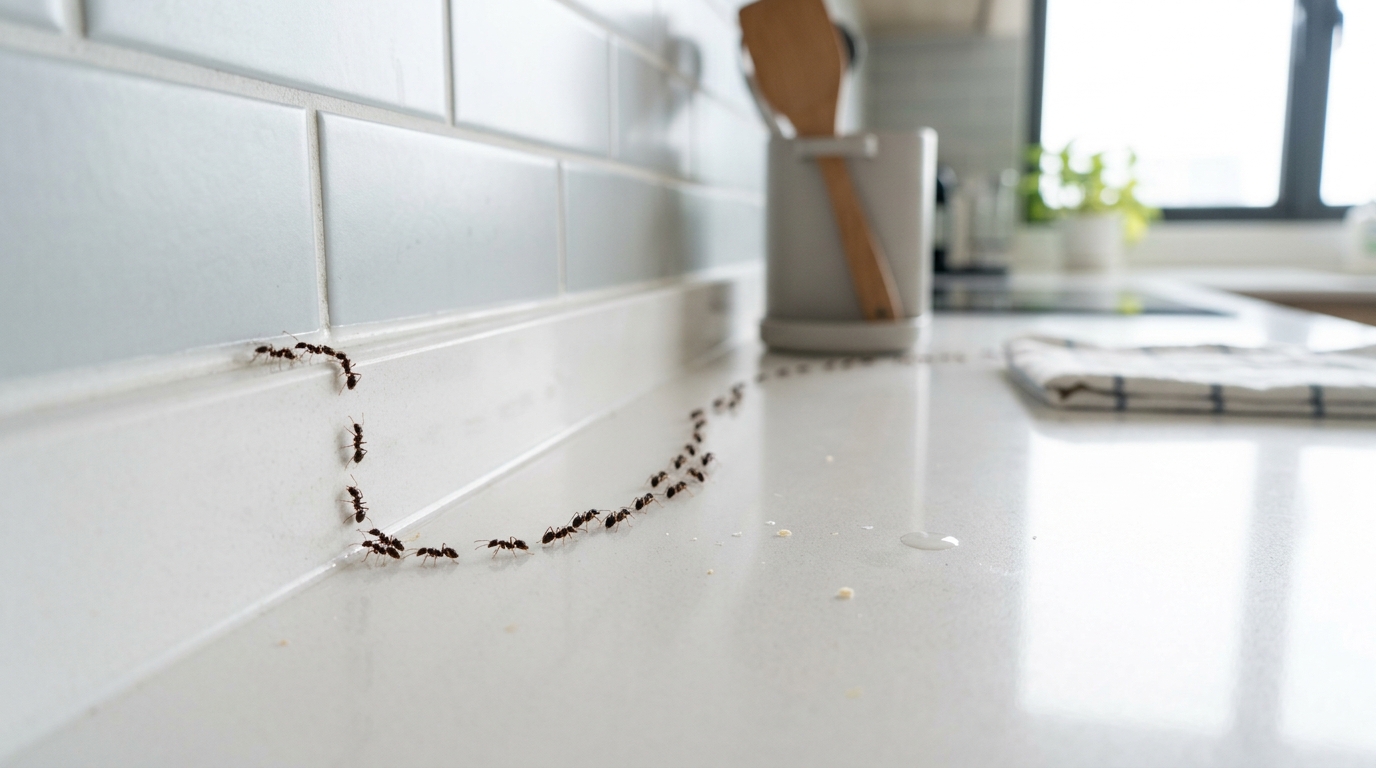
Not every ant problem is the same problem. A trail of ants across the kitchen counter might be a five-minute clean-and-seal fix, or it might be a colony that’s been quietly established behind the wall for months — and the difference usually comes down to which species you’re actually dealing with. Getting the identification right matters more with ants than with most household pests, because the wrong treatment approach for the wrong species can genuinely make things worse.
Why Ant Species Actually Matters for Treatment
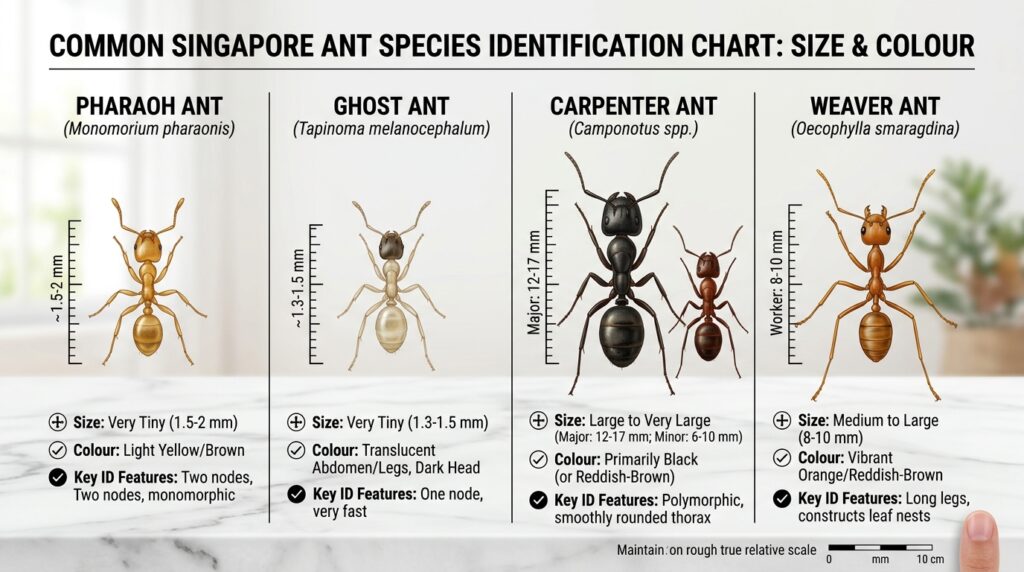
Most people treat “ants” as one category, but different species nest differently, feed differently, and respond to treatment differently. A method that works well on one species can be ineffective — or even counterproductive — on another. The clearest example is what happens when a Pharaoh ant colony is sprayed directly, covered in more detail below: instead of dying off, the colony can fragment and spread. Getting past “just spray it” and actually identifying what’s in your home is the difference between solving the problem and accidentally multiplying it.
Pharaoh Ants
Short answer: Pharaoh ants are tiny (about 1.5–2mm), pale yellowish-orange with a slightly darker abdomen, and one of the most difficult household ants to control because direct contact insecticide can cause the colony to fragment into multiple new colonies instead of dying off.
Pharaoh ants nest in warm, hard-to-reach voids — behind wall sockets, inside cavity walls, under flooring — and a single colony can have multiple queens rather than just one. This matters enormously for treatment: colonies reproduce by “budding,” where a group of workers and at least one queen split off to start a new colony elsewhere in response to disturbance or stress. Spraying a visible trail with a repellent insecticide is one of the most common ways this gets triggered — the ants scatter, and instead of one colony you now have several, spread across more of the property. This is precisely why professional treatment for Pharaoh ants relies on slow-acting bait that workers carry back to the colony, rather than any form of direct contact spray.
Ghost Ants
Short answer: Ghost ants are extremely small (1.3–1.5mm) with a dark head and thorax but pale, almost translucent legs and abdomen, giving them their “ghost” appearance, and they commonly form long, visible trails across kitchen countertops and along skirting boards.
Ghost ants nest both indoors and outdoors, often moving colonies between the two depending on moisture and food availability, which is part of why they can seem to disappear and reappear. They’re strongly attracted to sweet foods and moisture, making kitchens, bathrooms, and areas around pipes common entry points. Like Pharaoh ants, they can form multiple interconnected colonies, so seeing them in more than one room doesn’t necessarily mean multiple separate infestations — it may be one colony network operating across several locations.
Carpenter Ants
Short answer: Carpenter ants are considerably larger (6–13mm) and usually black or dark brown, and unlike termites they don’t eat wood — they excavate smooth tunnels through it to nest, which can still cause real structural damage over time in sufficiently large colonies.
This is a common point of confusion worth clarifying directly: carpenter ants are often mistaken for a termite problem, or vice versa, because both can be found in or near wood. The practical difference is that carpenter ants leave smooth-walled galleries and small piles of wood shavings (not mud tubes or waste pellets), and they’re active foragers seen moving around a property, not the hidden, cryptic feeders termites typically are. If wood damage and ant activity are showing up together, correctly identifying which one you actually have changes the entire treatment approach — worth a proper inspection rather than assuming.
Weaver Ants
Short answer: Weaver ants (commonly called “green ants” in Singapore) are large, reddish-brown to green ants that build distinctive nests from living leaves stitched together with larval silk, most often seen in trees around HDB estates, parks, and gardens, and they deliver a noticeably painful bite when disturbed.
Weaver ants are more of an outdoor nuisance than an indoor infestation species — they’re aggressive when their nest is disturbed and will bite readily, which matters for anyone doing garden maintenance or living near mature trees. They’re less commonly the species behind an indoor kitchen trail, but worth recognising since they’re one of the more visible and distinctive ants encountered around Singapore properties.
Black House Ants and Odorous Ants
Beyond the four species above, black house ants (sometimes called odorous house ants locally, for the faint smell they release when crushed) are another common sight in Singapore kitchens. They’re small, uniformly dark, and nest in a wide range of locations — under flooring, in wall cavities, in potted plants, and outdoors under debris — making them opportunistic rather than tied to one specific habitat. They’re strongly attracted to sugary foods and, like ghost ants, will readily move colonies in response to disturbance or changing conditions. They’re not usually confused with the four species above once you know what to look for, but they round out the realistic picture of “what’s the tiny ant in my kitchen” for most Singapore households.
Understanding Ant Colony Structure and Why Numbers Can Explode
A single ant trail rarely represents the true size of what’s actually nesting nearby. Ant colonies operate on a caste system — a queen (or, for species like Pharaoh and ghost ants, multiple queens) focused entirely on reproduction, workers that forage and maintain the nest, and periodically, winged reproductive ants that leave to start new colonies elsewhere. A mature colony of some species can number in the tens of thousands, all supporting a queen most homeowners will never actually see, since she rarely leaves the nest.
This structure explains why ant problems can seem to “explode” seemingly overnight. What’s really happening is usually one of two things: either an existing colony has simply matured to the point of producing large numbers of foraging workers, or — particularly relevant for budding species — a disturbance has triggered the colony to split into several smaller, harder-to-locate nests. Understanding this is part of why patience and correct identification pay off more than an immediate, aggressive response with whatever’s under the sink.
Quick Identification Comparison
| Species | Size | Colour | Typical Location | Key Behaviour |
| Pharaoh ant | 1.5–2mm | Pale yellowish-orange | Wall voids, warm indoor spaces | Colony fragments (“buds”) if sprayed directly |
| Ghost ant | 1.3–1.5mm | Dark head, pale/translucent body | Kitchens, bathrooms, near pipes | Moves colonies between indoor and outdoor sites |
| Carpenter ant | 6–13mm | Black or dark brown | In or near timber structures | Excavates (doesn’t eat) wood; often confused with termites |
| Weaver ant | 5–7mm | Reddish-brown to green | Trees, gardens, HDB estate greenery | Builds leaf nests; aggressive, painful bite when disturbed |
Signs of an Ant Infestation Worth Taking Seriously
- Trails that reappear in the same spot within a day or two of cleaning, rather than a one-off wandering trail
- Ants present in multiple rooms, suggesting a larger or more established colony network
- Small piles of debris (soil-like for some species, wood shavings for carpenter ants) near baseboards or wooden fixtures
- Winged ants indoors — these are reproductive members of an established colony preparing to start a new one, and typically indicate the colony has matured, not just arrived
- Ants persisting despite basic cleaning and food storage fixes, suggesting the colony is nesting inside the structure rather than just foraging in from outside
General Prevention Steps That Apply Across Species
While full removal strategy is species-specific and covered in a dedicated treatment guide, a handful of prevention habits reduce ant activity regardless of which species is involved:
- Store food in sealed containers, particularly sugary, starchy, and oily items that different species are drawn to for different reasons
- Wipe down counters and clean spills promptly, rather than leaving residue overnight for trails to establish around
- Take rubbish out regularly and keep bins covered, since food waste is a reliable outdoor-to-indoor draw
- Fix leaks and reduce standing moisture, especially relevant for ghost ants and other moisture-seeking species
- Seal visible entry points around windows, pipes, and skirting boards, without assuming this alone resolves an established indoor colony
- Trim vegetation away from the building exterior, particularly relevant for weaver ants and other outdoor species that can bridge from trees or shrubs into the building
These steps genuinely reduce the likelihood of a new infestation establishing, and support any treatment already underway, but for an established colony — particularly Pharaoh or ghost ants nesting inside wall voids — they’re a complement to professional treatment rather than a replacement for it.
Why Ants “Suddenly” Show Up
Ant activity in Singapore homes rarely appears entirely out of nowhere — it usually tracks a change in food availability, moisture, or weather. Heavy rain can drive outdoor colonies to seek drier ground indoors, small food or spill residues left overnight are enough to establish a reliable trail, and even a single unwashed dish can be the difference between ants passing through and ants deciding to stay. In HDB flats and condos, ants can also travel between units through shared walls, service ducts, and common corridors, which is part of why an ant problem can appear even in a consistently clean home.
A Note on Singapore’s Climate and Ant Activity
Singapore’s consistent warmth and humidity mean ant activity doesn’t really have an off-season the way it might in temperate climates, where colonies slow down or become dormant over winter. Colonies here can forage and reproduce year-round, which is part of why an ant problem that starts small can establish more quickly than homeowners expect. Heavy monsoon rain periods do produce a noticeable seasonal pattern of their own — outdoor colonies moving indoors to escape waterlogged ground — but outside of those spikes, baseline ant activity tends to stay fairly constant rather than dropping off for months at a time. This is also why prevention habits need to be maintained consistently rather than treated as a one-off spring-cleaning task.
When Identification Alone Isn’t Enough
For a small, occasional trail, general cleaning and food storage fixes are often enough. It’s worth a proper inspection rather than DIY guesswork when:
- The species appears to be Pharaoh ants, given how easily DIY spraying can make the problem worse
- Ants are showing up in multiple rooms or have persisted for weeks despite cleaning
- Wood damage is present alongside ant activity, where correctly distinguishing carpenter ants from termites matters
- It’s a commercial kitchen or F&B premises, where ant activity carries hygiene and compliance implications beyond a domestic nuisance
Our ant control services start with species identification specifically because the right treatment depends on getting that right first, rather than applying the same approach regardless of what’s actually infesting the property. An inspection typically involves tracing visible trails back toward their source, checking likely nesting sites (wall voids, under flooring, around plumbing, and outdoor vegetation near the building), and confirming species before recommending a specific bait or treatment plan. For households dealing with ants alongside other pest concerns, our residential pest control services cover the full picture rather than treating each pest in isolation.
FAQs
Frequently Asked Questions About Ant Species in Singapore
For questions beyond ants, our full pest control FAQ covers the rest of the site’s most common pest queries.
1. What ants are most common in Singapore homes?
- Pharaoh ants, tiny and pale yellowish-orange, often nesting in wall voids
- Ghost ants, tiny with a dark head and pale body, common in kitchens and bathrooms
- Carpenter ants, larger and black, nesting in or near timber
- Weaver ants (green ants), mostly outdoors in trees and gardens rather than indoors
2. Why do I suddenly have so many ants in my kitchen?
- A change in food availability, spills, or unwashed dishes can trigger a new trail
- Heavy rain can drive outdoor colonies to seek drier conditions indoors
- Ants can travel between HDB units through shared walls and service ducts
- A trail reappearing quickly after cleaning suggests an established colony, not a one-off
3. Are ants in the kitchen always a sign of infestation?
- Not always — an occasional trail from outside is common and often resolves with basic cleaning
- Trails that return within a day or two of cleaning suggest a more established problem
- Ants in multiple rooms point to a larger colony network rather than isolated foraging
- Persistent activity despite cleaning is the clearer signal of a genuine infestation
4. Why shouldn’t I just spray ants I see in my home?
- Spraying visible ants only kills what’s exposed, not the colony itself
- For Pharaoh ants specifically, direct spray can cause the colony to fragment (“bud”) into multiple new colonies
- Bait-based treatment lets workers carry the product back to the colony instead
- Species identification determines which approach is actually appropriate
5. How can I tell carpenter ants from termites?
- Carpenter ants excavate smooth tunnels through wood; they don’t eat it like termites do
- Carpenter ants leave small piles of wood shavings, not mud tubes or waste pellets
- Carpenter ants are active foragers often seen moving around, unlike cryptic termite feeding
- A professional inspection can confirm which one is actually present if unsure
6. Are weaver ants (green ants) dangerous?
- Weaver ants aren’t venomous but deliver a noticeably painful bite when their nest is disturbed
- They’re mostly found outdoors in trees, gardens, and estate greenery
- They’re less commonly the cause of an indoor kitchen ant trail
- Caution is mainly relevant during garden or tree maintenance near their nests
7. Does seeing flying ants indoors mean a bigger problem?
- Flying ants are the reproductive members of an established colony
- Their presence usually indicates the colony has matured, not that ants have just arrived
- It’s a reasonable trigger to look more closely for a nest nearby
- A professional inspection can confirm the extent and species involved
8. Can ants spread between HDB units?
- Yes — shared walls, service ducts, and common corridors can allow movement between units
- A clean, well-maintained unit can still experience ant activity for this reason
- Addressing entry points on your own unit still meaningfully reduces what gets in
- Persistent activity despite this may point to a colony nesting within the building structure itself
Expert Pest Control Guides for Homes & Businesses

Pest Free identifies the species first and applies NEA-approved, targeted treatment based on how that specific ant actually nests and feeds. Book an inspection rather than guessing with a can of spray.